
Your Home Is Your Biggest Investment. Stop Hiring the Cheapest Architect to Design It.

We wrote this piece because we kept having the same conversation — with clients who came to us after it was already too late. Read this before you start, not after.
Over nine years of designing homes across Delhi NCR, a pattern has emerged that no one in this profession talks about openly enough. A family walks in — not as a new client, but as a rescue case. They hired an architect a year ago, negotiated the fee down as far as it would go, and somewhere in the months that followed, things began to unravel. Miscommunication with the contractor. Reworks on work that had already been paid for. Decisions made without them in the room. Materials specified on paper and substituted on site. And a bill, at the end of it all, that far exceeded the fee they thought they were saving.
They come to us and ask: can you fix this?
Sometimes we can. Often, the damage is structural — in the decisions made in the first few months of a project that cannot be easily undone. Most of the time, what is left is a rescue operation on a home that deserved better from the beginning.
We wrote this piece for everyone who is still at the beginning. Before the brief is signed. Before the fee is negotiated. Before the decisions that will shape the next thirty years of your life are handed to the cheapest person willing to make them.
A PATTERN WE SEE MORE THAN WE SHOULD
The fee they saved in month one, they paid back twice over by year three — and were still living with the consequences.
The stories are different in their details. A Gurgaon home where the contractor substituted waterproofing materials and three monsoons later, an entire floor had to be redone. A Delhi farmhouse where the spatial layout was finalised without properly understanding how the family actually lived — and where the kitchen, the most used room in the house, faces north and receives no light after 9am. A Noida apartment where the "turnkey" builder managed both the design and the construction, and where the conflict of interest between those two roles — between what looks good on paper and what costs less to build — played out entirely at the client's expense.
In every case, the original fee saving was between ₹8 lakh and ₹20 lakh. In every case, the cost of reworks, corrections, and compromises exceeded it several times over. In none of these cases did the clients feel they had saved anything.
Think about how you choose every other professional in your life
When your child needs a specialist, you ask which doctor has the most experience with that condition. You ask which hospital has the best outcomes. You do not call three paediatricians, ask each one what they charge per consultation, and go with the lowest number. The thought is almost absurd — because you understand, instinctively, that you are not buying a commodity. You are buying judgment, formed over years of training and practice, that you do not have yourself.
The same logic applies when you engage a lawyer for something that matters — a property dispute, a business agreement, a family settlement. You ask who has handled situations like yours. You ask what their track record looks like. The fee is a detail at the end of a conversation about capability, not a filter at the beginning. Nobody has ever said: let me find the cheapest oncologist. Let me find the most affordable corporate lawyer for my company's acquisition. Because in those moments, you understand that what you are really paying for is the cost of getting it wrong — and with the right professional, you simply don't.
Now apply that same logic to your home. A 10 crore investment in land, construction, materials, and finishes that you will live inside for the next twenty to thirty years. A space that will shape your mornings, your evenings, how your children grow up, how the building ages.
The person whose decisions will determine all of that is not a vendor.
They are the professional equivalent of your surgeon and your lawyer combined — and the stakes are just as real.
A NOTE BEFORE WE GO FURTHER
Let's be clear about something. Budget matters. Of course it does. Nobody is walking into a project without thinking carefully about what they are spending. And a good architect — the kind this piece is arguing for — will never make you feel embarrassed for having one. In fact, the first thing a serious studio will tell you is that a clearly defined budget is not a limitation. It is the starting point of an honest conversation.
The point is not that money doesn't matter. The point is that it shouldn't be the first question — because asked too early, before you understand who you are actually talking to, it tells you almost nothing useful. A fee quoted without context is just a number. It doesn't tell you how many times that architect will be on your site. It doesn't tell you whether the person you meet in the first conversation is the same person who shows up on site eighteen months later. It doesn't tell you what happens when something goes wrong.
Ask about capability first. Ask about process. Ask about the work they've done and how it has held up. Then ask about the fee — and you will find the conversation is completely different, because now you have something to measure it against. Budget is not the wrong question. It is just a much better question once you know what you are actually buying.
"Are you willing to hire the cheapest person to design your life?"
The smartest clients already know this
A PATTERN FROM MY EXPERIENCE IN PRACTICE
The clients who negotiate least on design fees are almost always the ones who have built the most wealth themselves.
They understand, with the clarity that comes from making real financial decisions, that value and cost are not the same thing. They have seen — in their own professional lives — what happens when you try to save money on the wrong decision. A business owner who has hired the wrong lawyer for a critical contract, or the wrong consultant for a key project, knows exactly what that saving eventually costs. They bring that same understanding to their home.
They do not go hunting for the cheapest architect. They go looking for the most value. They know that spending once and spending well is always cheaper than spending less and spending again — and again, and again. That distinction, applied to a 10 crore home over a 30-year horizon, is the difference between an asset that compounds and one that quietly depreciates.
They think in outcomes
Not what does it cost, but what does it deliver — and what does getting it wrong cost instead.
They spend once
Right material, right decision, right professional. Not cheap now and expensive later.
They buy judgment
Experience that prevents the mistakes they don't yet know they're about to make.
They see the full picture
A 1 crore fee on a 10 crore project is 10%. The asymmetry of value it creates is never just 10%.
This is also, if I'm being honest, the clearest signal I have learned to read about whether a client and a studio are genuinely a good fit. Not the size of the project or the ambition of the brief — but whether the person sitting across the table understands that great design is not an expense to be minimised. It is a multiplier on everything else they are about to spend.
The fee is the smallest number in this equation
Here is the arithmetic that most people don't sit with long enough. A senior architect on a 10 crore project typically charges between 8 and 12 percent of construction cost. Let's call it 10 percent — that is 1 crore, across 18 to 36 months of active involvement in every decision your project will ever make.
A good architect, deeply engaged, will make spatial and material decisions in the first few months that determine whether your 10 crore investment eventually feels and functions like a 20 crore one — or a 5 crore one. Those decisions compound over the life of the building in ways that no renovation can fully undo. They will also save you money you don't yet know you're about to spend — on materials that look beautiful in a showroom and fail within three years, on spatial arrangements that read well on a plan and feel wrong to live in, on construction shortcuts that a well-supervised contractor would never get away with. The fee does not just pay for design. It pays for the prevention of a category of expensive mistakes that you will never see, because they simply don't happen.

What does a low fee actually mean in practice?
This is the part of the conversation that nobody has plainly enough. When a client negotiates an architect's fee to 10 or 15 lakh on a 10 crore project, it sounds like a win. Until you do the arithmetic of what that actually means for the studio on the other side.
A project of this scale runs anywhere from 18 to 36 months. Let us be generous and say 24. Spread 12 lakh across 24 months and you arrive at 50,000 rupees a month — before studio overheads, before salaries, before rent, before the cost of the software, the site visits, the printing, the material research. In the world we are currently living in, with the inflation that has moved through every cost a design studio carries, that number does not sustain a team. It does not even sustain one senior person's meaningful attention on your project.
THE SIMPLE MATH OF A LOW FEE - WHAT IT ACTUALLY MEANS Based on a ₹12–15L fee on a 10 crore project over 24 months | |
Total design fee received | ₹12–15 L |
Project duration | 24 months |
Fee per month (gross) | ₹50,000–62,500 |
Studio rent + utilities (est.) | ₹20,000–30,000 |
Software, printing, travel | ₹8,000–12,000 |
Site visit costs (2x/month) | ₹4,000–6,000 |
What remains for the architect | ₹8,000–20,000/month |
No studio can sustain itself — or your project — at this number. Something has to give: either the number of projects taken on simultaneously increases, the depth of attention per project decreases, or revenue is supplemented through other arrangements. In none of these scenarios does your project get what it needs. | |
A studio that cannot sustain itself on your fee will do what any rational business does — it will spread its fixed costs across more projects. Which means your home, which demands consistent attention across two to three years, now shares a team with three or four others. The site visits become less frequent. Decisions get made faster. The contractor, sensing reduced oversight, begins to operate with more latitude than you would ever knowingly give them. This is not a judgment on anyone's character. It is simple economics — and your project is what absorbs the consequences.
The only other person in the room who actually cares
EVERYONE ON YOUR PROJECT - AND WHAT THEY'RE ACTUALLY THERE FOR
On a construction project, there is exactly one professional whose name stays on the building after everyone else has been paid and moved on.
The contractor
Efficient delivery, cost control, margin
Does good work when supervised. Moves on when complete. Has no stake in how you live there.
The vendors & suppliers
Volume, turnover, the next order
Their interest ends at the invoice. The material in your home is not their concern once it leaves the showroom.
The structural engineer
Technical compliance, safety
Indispensable for what they do. Not present for the thousand daily decisions that define your experience of the space.
You — the client
Your home, your life, your investment
Fully vested. But without the technical knowledge to know which battles to fight, which shortcuts to refuse, which decisions will matter in ten years.
Your architect
Their reputation lives in your walls long after the project ends
Every built project is a permanent, public record of their judgment. A good architect is not just contractually involved — they are professionally, reputationally, and personally invested in the outcome. Every material decision, every spatial choice, every moment on site where they push back on a contractor cutting a corner — that is not just service. That is their name on the line.
In a room full of professionals who will be paid and move on, your architect is the only one whose career is attached to the outcome of your home. Why would you cheap out on the only other person in the room who actually cares?
Think about what that means in practice.
The contractor wants to finish on time and protect their margin.
The supplier wants to move product.
The project manager wants the schedule to hold. All of these are legitimate interests — and none of them are yours.
Your interest is a home that works, that holds its value, that you are proud of in twenty years.
The only professional in that room whose interest naturally aligns with yours — whose reputation requires that yours is satisfied — is your architect.
Negotiating their fee down is not a saving. It is reducing the depth of investment of the one person whose incentives are structurally on your side.
Spend once. Spend right.
The people who build the most enduring homes — the ones that look as considered in fifteen years as they did on day one — are rarely the ones who optimised for the lowest design fee at the start. They are the ones who made one good decision early and let every subsequent decision flow from it. They spent once, and they spent well.
The alternative — saving on the fee, reworking in year two, redoing in year five, living with the compromise in between — is not a saving. It is the most expensive way to build a home, spread across a timeline long enough that the connection to the original decision has become invisible.
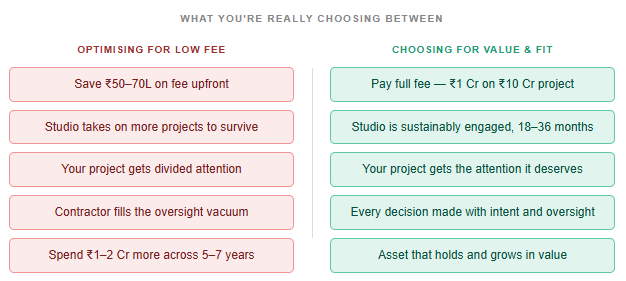
I have sat across the table from clients who spent less on their architect and significantly more on their contractor, because no one was present to stop the contractor from doing things the easy way. The fee they saved in year one, they spent twice over in years three and four. I have yet to meet a client who, looking back, wished they had paid their architect less.
So what should you actually ask?
Ask to see work that has been lived in — not just photographed on completion day. Ask how many times the principal architect visits site per month on a project of your scale. Ask how many projects they are currently running, and whether a project like yours will receive consistent senior attention. Ask what happens when a contractor makes a mistake. Ask whether they can take a project from concept through to execution — and hold the whole process together.
These are the questions that separate a studio that will genuinely multiply the value of your investment from one that will merely produce documentation for it. The fee conversation, when it comes, will look entirely different once you've had this one first.
In our experience
Across dozens of completed homes in Delhi NCR, we have never once had a client look back and say they wished they had paid their architect less. We have, however, spent more conversations than we can count helping people understand the cost of having paid too little — after the fact, when the options have already narrowed.
Your home will outlast most of the decisions you will ever make. The person who designs it is not a vendor. They are the professional whose judgment, whose presence on site, whose willingness to fight for the right detail on a Tuesday afternoon — will determine whether the most significant investment of your life becomes the space you always imagined, or a permanent record of the corner you cut at the beginning.
The question is not whether you can afford a good architect. It is whether you can afford not to have one.

BEFORE YOU COMPARE ARCHITECTS BY FEE
Spend one hour understanding what you're actually investing in.
Our paid initial consultation is not a sales meeting. It is a structured conversation where we help you evaluate your project, your budget, your brief, and your priorities — and where we are honest about whether we are the right fit for each other.
how to choose an architect in Delhi | architect fees India | hiring an architect | design and build Delhi NCR | home construction mistakes | architect vs turnkey builder |


Comments